Wednesday, March 28, 2012

If I Ran an Alt Weekly ...

A few weeks ago, I was asked to come up with a list of things I would do if I were the editor of a local alt weekly. It seemed to me that there are five areas that need consideration:

1. An alt weekly needs an identity.
2. It needs to justify why it is in print.
3. The business-side and the editorial folks need to work together.
4. Recognize the strengths and weaknesses of online, and staff accordingly.
5. Develop partnerships, as the alt weekly staff alone cannot be comprehensive.

When you get right down to it, these are not concepts that are unique to alt weeklies. So, I'm posting my full notes here as I think they apply to all print media and possibly all media in general. (Specific names have been removed).

1. The paper needs an identity.


• Who is the audience? The target audience should be young, educated and cultured people. And the people who wish they were young, educated and cultured.
• It might even be wise to focus on a tight geographic coverage area. Because of limited resources (i.e. staff and print space), decisions must be made about what and where gets covered. The paper should focus on city life, appealing to those who live here and those interested in city living.
• The paper should champion the city and its citizens. Always.
• There needs to be something that draws readers back every week.
• I suggest a regular columnist who crafts first-person, Philadelphia narratives that revolve around being a 20-something involved in stuff.
• My initial thought is (name removed). He’s intelligent, artistic and connected in the youth culture scenes (dance parties, art shows, squat houses, etc).
• This is not a reactionary-type of opinion story. These are scenes from the life of a young Philadelphian.
• The writers and top editors need to be in front of people constantly. Deals need to be made with local TV stations so that staff are on air regularly (every week at minimum).
• The editor needs to be everywhere, talking to everyone.

2. You need to justify why the paper is in print.

• This is not a newspaper, and the small staff will never compete in the realm of breaking news. Rather than focusing on breaking news or timely events, the paper should think about ideas, trends and in-depth, long-form reporting. What (or who) is the next big thing? Stories should be well-written, with characters developed and crazy plotlines. There must be scenes and action.
• Emphasis on engaging writing.
• (name removed)’s column should be every week but shorter (750-words) and less-timely. The writer should be using individuals to tell stories about relevant issues. They do this now at times.
• The staff writers should concentrate on cover stories. If you are going to employ or contract writers, you need to get the most out of them. They would be on the hook for one long story (3,000-words) every five weeks, on average. And it’s fine if the columnist's weekly pieces intersect with the longer stories – that is part of the continuum from week to week.
• I think the long stories should be three pages, with large images or art. Open with two, facing pages, then go to an ad page (or two), followed by the remainder of the story.
• The long stories are not always the cover. Think of this like a weekly magazine. The cover is the best, most intriguing art. Sometimes that will be the longer story. But sometimes the longer story is a think piece that is not especially visual. No need to force this.
• The paper should be visually striking.
• Theater, music, movies and art should focus on previews, not reviews. Reviews of things that have passed are irrelevant. Negative reviews or previews are also irrelevant. With limited space, focus instead on what people should be doing/ listening to/ seeing/ whatever … not what they should avoid. It is essentially a negative review/ preview when people/ places are ignored.

3. The business side and the editorial side should work side-by-side, but remain independent.

• There are currently 14 or so pages of editorial content every week. The ratio for ad to editorial is dismal but let’s work within that frame for now.
• There needs to be an awareness of juxtaposition. Right now, the paper has massive ad clutter. It looks like a shopper. I would suggest a better blend of ads and content (for instance, make the calendar pull across the double-truck). Design matters.
• Local advertisers are absolutely essential. But they will get lost in the clutter. How about this deal: if an advertiser locks into a long-term, multiple issue deal (say 5 issues), they get a larger ad every fifth issue.
• The paper needs national ads. Clothing brands. Beer companies. Sneaker makers. While the overall product may not be intended to be a lifestyle magazine, the reality is that the target audience is marketable.
• I would move that youth/ city life columnist to page 46, and run it alongside (name removed)'s current column. That way, readers will flow from the arts & entertainments sections through the ads, to the back of the issue.

4. The Web is a marketing tool, a place for bundled ads and a place for reviews and breaking news.

• There are no ads on the three primary blogs. If you aren’t making money there, don’t waste time generating content (leave it to the interns, as much of it is now).
• Start generating money on those blogs.
• Review every album that comes in the door, especially from Philly bands. That will draw web traffic.
• Re-post band’s YouTube videos constantly.
• Make the website an aggregator of content the readership might be interested in. But forget original reporting until there is enough revenue to fund multiple staffers who concentrate primarily on web stuff.

5. Partnerships.


• It might be wise to contract or partner with an existing blogger (or two) who can supply content for online.
• Maybe the paper's stories can be connected to HuffPo?
• There must be a TV partnership. That exposure is invaluable.
• It might be good to partner with local colleges. Drexel, for instance, now covers the art scene for the Daily News. And they received foundation money to do the deal.
• I think it’s important for people to think of the paper as being a part of the community. That idea must be fostered. And people must feel as though they are part of the process (we should solicit story ideas, hold town hall meetings, invite reader stories and comments, etc).

Monday, February 27, 2012

And Now, The End is Near.

Larry Platt announced that the Daily News and Inquirer officially begin sharing content today. Sports, news and other stories/ photos/ graphics/ art you see in one paper may wind up in the other.

Of course, this has been happening now for a while. The two newspapers, which are owned by the same company, merged their photo staffs about a year ago. Images you see in the Inquirer have been winding up in the Daily News, and vice versa.

From a journalistic standpoint, this is concerning. Competition drives people to work harder, to uncover more and to just plain be more aggressive.

From a business standpoint, this is outright stupid. Rather than have two competing papers - serving two differing audiences, with different content and different identities - we now have one news operation trying to serve a geographic region that runs from Atlantic City to Harrisburg, from Trenton to Dover. They can't cover that comprehensively, even with the merged staffs.

Thus, the operation will merely offer the facade of documenting the region. Communities will be ignored except when bad stuff happens. Readers will not feel a connection to the papers as they aren't represented in those pages. They'll quit buying them, and maybe opt for a local alternative or nothing at all.

Worse, this massively opens the door for the New York Times to sweep in and absorb the rest of the reading public (especially the wealthy and educated) in the region. Good for the Times but who will document the Greater Philadelphia region?

Not only is the merging of the Daily News and Inquirer staffs the beginning of the end of the Daily News, it is likely the death knell for both newspapers. They have sufficiently rendered themselves obsolete.

And that is so sad.

It's not too late! Rather than spiral downward, here are my suggestions:

1. Identify your audiences. The Daily News, for instance, was the city paper, speaking to the blue collar workers and interested parties. There is a niche that can be capitalized upon. The proposed direction is far too broad. Figure out who you want to reach and what content they need/ want.

2. Make the Inquirer and Daily News massively different, top to bottom. Then, you have two distinct products that you can sell and different markets you can reach.

3. Don't put everything from the newspapers online. Only post teasers, breaking news, updates and multimedia stuff. Make people want to buy the papers, especially if that is your primary revenue source. Recognize the strengths of the Internet and use it accordingly (otherwise, why be in print at all?).

4. Recognize that journalism matters. Competition isn't "needless duplication." Competition is the catalyst behind good reporting, better art, innovation, creativity, etc. Competition should force staff to think, "What can we do differently from the other guys?" Competition should force you to think, "How can the newspaper story be different from the online content?"

Frankly, calling it "needless duplication" is a cop out. It's hedge fund speak for, "We're eliminating jobs because the profit margins aren't high enough."

And the fact that Larry Platt (seen above in images from Gawker) announces these changes as though he's doing the public a favor? I've lost any respect I ever had for the man.

Monday, February 13, 2012

Hey Philly, I Think Whitney Houston Died?

Back in the early 1990s, the Philadelphia Inquirer embarked on a new venture - television news. Their one-hour long 10 pm broadcast featured longer packages that were, in theory, more thoughtful and beyond the reactionary news typical of local newscasts. There would be newspaper reporters working with the broadcast folks to develop this more cerebral news.

It didn't work. Fraught with union issues and tensions between the print and broadcast sides, the experiment folded quickly. After a few months of longer stories, the newscast devolved into the typical run-and-gun newscast. They burst through the hour with a load of stories, few with any thought, mostly reacting to events rather than being proactive.

The Inquirer bailed from the project after about a year or so. The newscast continues today but is now fueled by one of the other local newscasts (the local NBC affiliate). The news you find there is nearly exactly the same as you would find on any of the other newscasts. It barely draws an audience.

So why does it need to exist?

I think of this today, when the covers of all three daily Philadelphia newspapers feature stories and art of Whitney Houston, the Newark, NJ native who died on Saturday in California. She has no connections to Philadelphia, except that she recorded her first album here. Beyond that, she was an international celebrity, meaning you will find news about her everywhere today (not to mention yesterday, and two days ago).

To me, this is a massive waste of resources. People already know Whitney died and that the Grammy's honored her. The Internet spread that information quickly. This is redundancy on the grandest scale.

If you are only going to do the same thing that everyone else is doing, you are competing with the world. There is no reason for you to exist, really. If you focus on what you can do that no one else does, however, you create value in your product.

Focus on local. Focus on what you can do that is different from everyone else.

Friday, February 10, 2012

Start-up Journal: A Few Things We've Done Right.

We're in production with issue five and things are lining up quite nicely. We have some really strong content and financially, we are hitting our goals.

This is all a huge relief, as in the past around this time (three weeks before going to press), I've been freaking out. Here's why I'm feeling good now:

• We established a partnership with the School of Rock. They're building a magazine that will run in the inside eight pages of JUMP. This is such a smart partnership - they have a similar mission (music is awesome) and their content is in line with ours (all local and all music). They pay us a modest sum for the space. We get content. They get distribution and a wider audience.

We've done other partnerships in the previous issues but the synergy has never quite lined up. I think we finally found a balance where both parties mutually benefit.

• Because of what we've done in the previous issues, people want to be in the mag. They want to work with us. The spring issue features a cover package with Chiddy Bang. These guys are about to blow up in a HUGE way. Their PR people, who also represent Jill Scott, reached out to us after they saw the Jill cover in November.

• In every issue, different people step up and do awesome, massive amounts of work. Rick Kauffman photographed everything in the winter 2011/2012 issue and because of his work, that issue popped. Colin Kerrigan shot both cover stories for the upcoming issue, and he wrote the Chiddy bang story.

• I still blow at selling ads but my humble approach seems to be working on folks. Rather than sell people on the notion that advertising with us will help their business explode, I explain our mission. We want musicians to stay or come to Philly, and then thrive here. We want Philly to be known as a music town (rather than a place rife with violence and corruption). Our pro-Philly, "support local music" agenda resonates with people.

• I've been meeting with musicians and music industry folks who have all spoken kindly about the magazine. They read it, and then they keep it around.

In addition to all of this, we'll begin streamlining the production process with the summer issue. We would have worked the better process into this issue but I've been dealing with a world of crap (sick puppy, sprained ankle, root canal, etc).

We've developed a sustainable product and it didn't break the bank. There are many other journalism start-ups in the region that are burning through obscene amounts of money (while producing little or nothing) and several that have folded recently. JUMP reaches an engaged audience and covers topics that get scant coverage elsewhere. Our business model has us building upon these successes.

Here are our next goals:

1. Begin paying staff for content creation in 2012. This is doable if we get a few more advertisers (basically need to sell four more pages per issue).
2. Bump to six times per year in 2013. This is only doable if Governor Tom Corbett has his way with the state budget and my job disappears. That's very possible. We could also do six issues per year if I seriously neglected my dog, girlfriend, job and friends. That's not likely to happen though.

Wednesday, February 1, 2012

The City That Loves You Back (If You Have Money and Know the Right People).

I DON'T KNOW JIMMY BINNS, the local lawyer who sports pin-striped suits and drives a Jaguar. I know that he gives a ton of money to the local police department (which seems like an odd practice for a lawyer, a potential conflict of interest somewhere, no?).

I also know that Jimmy Binns is not a member of the police department. I know that when I saw his vehicle, parked illegally on the sidewalk, in front of my neighbor's garage door, he was not on official duty (he was at a coffee shop with a police sergeant, as he is on many mornings). And despite his honorary police commissioner status the city designated upon him (again, how is this not a conflict of interest?), he is never actually on official police duty.

So why is he rocking the "Official Business" placard from the commissioner's office?

This is clearly not the greatest sin in a city with many evils. But it is a clear sign that people with access to power receive special treatment.

The fact that this guy donates money and supplies to our police officers (and firefighters) should not allow him the privilege to be an asshole. And that parking job, which is blocking the entrance to an active business, is the move of an asshole. He knows he's in the wrong - that's why he threw his placard up there.

Tuesday, January 17, 2012

There's Only One Thing That Matters.

Today I learned that my dog has early signs of congestive heart failure, and that his health is quickly diminishing.

For anyone who knows me, you can only imagine how devastated I am. Mookie is my absolute best friend, my constant companion. The thought of losing him paralyzes me.

I always knew he had a shorter lifespan than me, and that someday I'd lose him. But he is only 9-years old. It's too soon.

If life is so fragile and unpredictable, why do some people get so angry? Why do people bother with trivial arguments, competing with people, jockeying for money and power? Why do people steal and lie and become greedy? Don't they realize that none of that matters?

All I want in life is more time with my best friend.

On proper medications, Mook may live several more years. But he could also pass away at any moment - with or without the meds.

For now, I will enjoy our time together as much as I can.

Monday, January 2, 2012

Giving Thanks to Those Who Helped Me.

I hate new year's resolutions, almost as much as I hate end of the year lists. Both are ridiculous (lists are just lazy and resolutions are for the weak). I'm also not a fan of declaring goals for yourself at the start of the new year.

Rather, I'm a fan of appreciating everything you have, at all times. And since I've been feeling pretty fortunate about my life lately, I wanted to take a minute to publicly acknowledge a few folks who've gone out of their way to help me with stuff over the years. Without them, I probably wouldn't be sitting so pretty.

I'm not talking family - they're supposed to be there for you. I'm talking about folks who believed in me enough to lend their support. Three people come to mind immediately.

1. The fellow in the snazzy hat in the above picture was my college journalism professor, Andrew Ciofalo. I was in a few of his classes at Loyola College and I enjoyed his teaching style - hands-off, relying upon experiential learning. Rather than preaching ideas or simply lecturing, he gave us goals and asked us to reach (or surpass) them. He instilled a sense of pride and ownership of the projects that made us want to do a good job.

Of course, many people skated through such classes. And a few people accused him of not actually teaching. But for me, it was effective. I didn't know what I could do and he forced us to experiment and push our boundaries.

When I was an undergrad, Ciofalo said to me, "If you go to Columbia for grad school, I'll bring you along on this study abroad program I'm planning for Rome."

So, naturally, I went to Columbia. A few years after graduating from J-school, I stopped by Ciofalo's office at Loyola. It was the first time I'd seen him in nearly a decade and I reminded him of his promise. He responded, "We just started a summer program in Italy last summer. You should do it with us next summer."

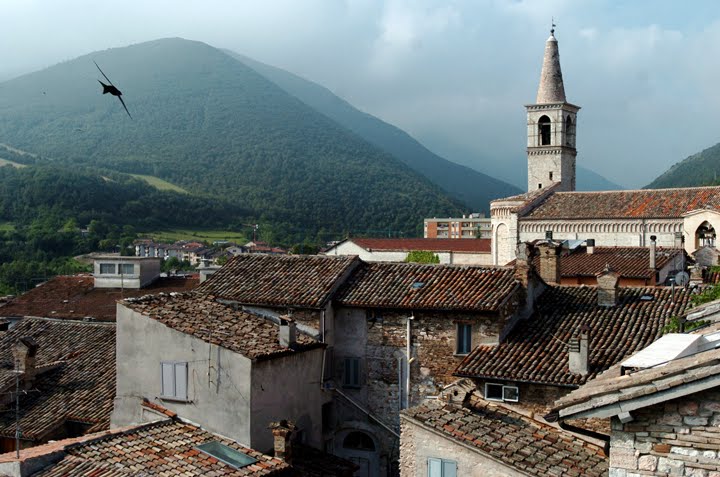
And I did. In the summer of 2003, I spent seven weeks teaching photojournalism in Cagli (right), possibly the most charming place on Earth. I returned three more summers (twice in 2006), and then taught in Ciofalo's program in Northern Ireland in 2007.

The programs were wonderful experiences - hanging in the piazza, drinking wine with students as we discussed photo ideas and journalism concepts. I bet the students didn't even realize they were learning. It was immersion in the local culture as well as immersion in education. I met so many great people who I still maintain friendships with, students and Italians alike.

Ciofalo also hired me as an adjunct at Loyola, starting in 2004. I taught all sorts of writing classes over the next three years. That experience, along with the summer abroad stuff, led me to the job I hold today.

I owe Ciofalo big time, and I would do just about anything for the guy (as well as for his ex-wife, Judy Dobler, who was also one of my favorite and most influential teachers when I was at Loyola).

2. I contacted Tim Whitaker during the fall of 2005 and told him that I wanted to write for the Philadelphia Weekly. I had not written anything longer than 1,500 words during my time at the Daily News but Tim was totally into it. He started assigning me stuff in January 2006, a few weeks after I took a buyout from the Daily News.

He gave me a chance to write long - 3,000 to 5,000 words. It was great. I experimented with style and voice, and Tim (along with editor Sara Kelly) gave me room to breath. I wrote several cover stories that year and more the next. Until Tim's time at PW ended in 2008, I wrote dozens of stories for him, including a column.

But it was more than just the freedom that he offered. He invited me to be a part of the process, something that I never experienced during nearly 12 years at the Daily News. He asked me to come speak to the young writers and interns, and he had me sit in on a few staff meetings. He actually valued my input and ideas.

When Tim launched Mighty Writers (above), a free writing program for Philly kids, during the fall of 2009, I offered my assistance. I taught a workshop that fall. I wasn't good - teaching little kids is way different and much harder than teaching college kids (which, by the way, isn't easy either). But I was invited back the following fall, and later, Tim invited me to be on the advisory board. They don't ask much of me but they seem to appreciate every little thing I can do for them.

3. I don't remember how it came about but Susan Gregg invited me to meet with her at Wilmington College back in 2001. Despite my never having taught anything, she invited me to be an adjunct at the university. She gave me a world of leeway, a little bit of advice and then sent me into the classroom. And it was amazing. I loved it from day one.

Not all of the students did. I was a rookie and I made some mistakes. But I would sit with Susan and talk about stuff and she guided me to become a better instructor.

The basics that I learned from her are really the foundation of my teaching skills. And if she had not given me an opportunity, I might not be a full-time professor today.

Speaking of teaching ... I had a few really, really great professors over the years and I've stolen from their teaching styles: Ed Ross at Loyola, Michael Shapiro at Columbia, Pete Rock and Valerie Ross at Penn, Seth Bruggeman at Temple.

I never took a class with Tom Eveslage but he asked me a question when I was speaking to one of his classes at Temple and it changed my entire pedagogy: "What is the process you use to determine whether to do the story?" Process? I had never consciously had one. Now I have a process for everything, and I preach them all to my students.

I am the person I am largely because of these people. I try to emulate their best traits - when I deal with students, when I write stories or shoot photos, when I see people out and about.

Of course there are others: Mookie. The Daily News photo gang. The 8th & Poplar baseballers. My roommates from Loyola. Russ Campbell. My Uncle Noriyuki (yeah, he's family but I don't see him that often, and there is no one else in the world whose principles I respect more).

For these folks, as well as Wendy and the rest of my family, I would do anything. I owe them so much.

Sunday, December 4, 2011

Start-up Journal: Jill Scott is Too Glamorous for Hipsters?

Just realized that I had not posted the winter 2011/2012 issue of JUMP featuring Jill Scott.

Lot's of stuff to talk about with this issue. The most interesting thing, to me, has been the reaction to the Jill Scott cover. The mag moved slowly in whiter, hipster areas - guessing the trendy white kids weren't drawn in by the glamorous looking Philly native in the shiny dress. I flipped the mag after a week or so at a few hipsier joints, fronting the artwork by Andy Molholt (below), and the mag flew from drop spots.That said, I dropped stacks of 50 mags at the FYE at Broad and Chestnut at least five times, each time fronting Jill Scott. On Friday, two days ago, I dropped off another stack at around 4:00 pm. By the time the store opened Sunday morning, there were only three copies left. I've also hit Reading Terminal Market three times with stacks of 50.

Not sure what to make of that. The mag clearly has appeal with certain people. I don't know how we capitalize on that - financially or with future distribution. My thought is that every issue should always have two covers (rather than selling the back as ad space). That way, we can front the side that is more likely to draw readers at different locations.

I can tell you that we will not cover any genre of music with greater emphasis. The goal is to show off the musical talents of the city and our folks are awesome in a variety of genres. We'll use a cover to draw them in but once inside the mag, they will find a world of awesome stuff (not just their genre).

We held three launch events - at Temple University, the Hard Rock Cafe and The Blockley. They were all great fun but I never want to host another event again. I know that events are good for marketing and promotion, and even possibly good for generating revenue, but I am not a promoter. I have no interest in doing that kind of stuff. It's nerve-racking and not worth the stress.

We appeared on XPN2 with John Vettese. We set the playlist for an hour-long broadcast, featuring music we've documented in the magazine. That was cool.

I despise lists in journalism (first of all, they aren't journalism - they are pure marketing; second, they are lazy). We will never run a top ten list or anything even close. We will not present awards of any sort. They are meaningless. That said, we are up for city publication of the year in the third annual Philebrity awards. It's a bullshit, meaningless award but I want to win. As a new publication, we need any validation (and recognition) we can get.

We have other cool stuff on the horizon. For instance, we started a partnership with Philly Beer Scene magazine in which we'll do a regular column about beer and music (the first story is in the newest issue of Philly Beer Scene).

That relationship was born out of a magazine collective we created with Philly Beer Scene, Grid, Origivation, Motivos and two.one.five (if they ever print again). Not sure how the collective will work together but we're thinking there are commonalities with advertising, printing, content-creation, distribution and other back-end services.

This is very exciting to me as I really enjoy the people in this collective. They are bright and innovative - recognizing that print isn't dying. It's big media that is in trouble. We have all created publications that are primarily print and loved by their respective audiences (JUMP may not be beloved yet but when people see the mag, they become instant fans). Innovation doesn't always mean digital. Innovation is recognizing niches that can be served and building business models that can be sustainable (and profitable).

Other interesting JUMP stuff: got a few more major advertisers and I have been talking with another music organization about running their publication as an insert in JUMP. Things are lining up nicely for 2012.

Saturday, November 5, 2011

Start-up Journal: JUMP Year in Review.

I'm the guy in the front row at concerts, usually with a big, stupid grin and bouncing up and down. I love to see talented people performing. I think it's part jealousy - I wish I was up on stage, and part admiration.

One of the greatest things about running this magazine is that it is an excuse to go out, have fun and listen to live music. Not that I needed an excuse but my life is pretty jammed and it can be exhausting. Given the option, I will fall asleep on the couch. But now that I have to attend concerts, I throw down some espresso and hit the town. It's pretty awesome.

Speaking of awesome, I have to say that our latest issue (issue #4), which officially hits the streets on 11/11/11 (though I pick them up from the printer on Monday), is probably the most awesome pop culture, truly Philadelphia magazine in many years. It looks good, it reads well and it covers so much diverse information that it is almost overwhelming.

In this issue, we have Jill Scott, but the story doesn't hinge on her music. Rather, we talk about her dedication to Philly via her foundation. She provides scholarships and training to young people from her neighborhood who otherwise might not have the means nor ambition to do positive things in their lives. She gives them hope.

We have stories about the Philadelphia Gay Men's Chorus, an opera-singing pizza maker, artists who make music posters, hard rock bands, dubstep DJs, hoop dancing, politics, education and so much more.

After printing four issues, I've discovered a few things:

• This is a doable project. Even with my regular, full-time job (I'm teaching around 350 students this semester), I can do this magazine on the side. It eats my life but it is doable. For the month of October, while I was editing and doing layout, I worked on the magazine non-stop from Thursday evening until Sunday evening. I did not sleep. I did not party. I quit playing baseball (that sucked). I ignored my friends. But we got the mag done.
• If I had more time, I could sell more ads and make the mag financially sustainable very easily. There is interest in the product and loyalty from the readership. Our ads are cheap enough that businesses can afford to advertise.
• For this issue, we nearly covered our costs - though that includes a credit from the printer because they goofed up the printing in the previous issue. With winter break coming up soon, I will dedicate four weeks to getting advertisers. I'm feeling pretty good about it.
• Selling ads blows. I take every rejection personally, and there is a lot of rejection. I can't even tell you how many people have blown me off over the last ten months. There are so many more people on my permanent shit list than ever imaginable.

• There is a pattern to production. Story deadline passes and I have few story submissions. Then I freak out and think about shutting down the mag. A few weeks later, I have more than enough content to fill the mag, and I feel like king of the world. This has happened with every issue.
• This is my fault. I am an easy going guy so I don't yell at people when they miss deadlines. I coddle people too much. Now that we have a good core staff and a ton of people interested in contributing, the bullshit is over. You miss deadline and you will never, ever contribute to the mag. There is no reason I should have to stress about that.

• I love the magazine and everything in it. It is far more than just music. We use music as an excuse to talk about Philadelphia. When you read the mag, you experience the city, and you see way more than you would ever find in other regional publications. That's not a slam on them. It's a product of our lack of advertising, abundance of content and my determination to be diverse.

The mag will continue to exist and that's pretty amazing. People like the product - it's print and real, as opposed to the ephemeral nature of the Internet. Our costs are minimal, so the money situation is not out of reach.

Plus, I like attending shows. Being an adult can suck - the realities of work and bills and bullshit obligations can be a real downer. It would be very easy to sit around watching Netflix all day. Instead, I go out all the time (except during production months) and have fun, experiencing so much.

Here are some of my favorite things I've gotten to do because of the magazine:

• Interviewed Mayor Nutter.
• Hung out with Freeway.
• Saw a ton of bands at the Philly FM Fest.
• Spent 12 hours at The Roots Picnic.

I've spent so much time with bands and artists away from the stage, learning about them and their inspirations. I've had the pleasure of learning about talented people who are passionate enough to push onward despite the chances of making a bigtime career out of music being slim.

Running the magazine has been a real treat and I look forward to next year.

Saturday, September 17, 2011

Start-up Journal: Where Do Hits Come From?

I attended an event at WHYY the other day where they discussed their new operation, Newsworks. It's a collaborative effort that brings together around 20 different regional journalistic outlets under one umbrella.

Over the first year of operation, they say they've had many successes and failures. The one thing that stood out to me most was that only 13 percent of their audience found content on Newsworks by going through the home page. The rest of the hits came from people who were led to the site via facebook, twitter, search engines and other links.

I just went through our numbers from JUMP. Since the March launch, we have 34,586 total hits. Only 10,655 went through the home page. That means the actual website draws only about 31 percent of the audience. We've had 7,767 hits (22 percent of our total hits) through facebook. Our twitter hits are only at 973.

What are the ramifications of this?

• Well, it makes me realize that I probably don't need to worry about updating the website every day. Two-thirds of our audience aren't even seeing the home page.
• This makes me think that I should be taking advantage of all our online content, not just the newest stuff. I should post and re-post all the old stories all over the place (especially on facebook), as the website really is just a marketing tool for the print magazine.
Twitter blows as an audience generator. It's fine for getting our name out there, so we'll continue with it. But twitter followers don't seem that interested in info beyond 140 characters.

• Most importantly, all of this makes me realize that the web is not a content-generator friendly medium. It is fantastic for users - they can find whatever info they want, whenever they want. But the content-producers are working in a void (and not making money online).

• This reaffirms my commitment to print. The Internet, I think, actually devalues content by nature of requiring so much of it. Print is permanent (or at least lasting) and therefore valuable.